
Along with the rapid worldwide spread of Japanese culture, the Japanese language has quickly become one of the most popular languages to learn in the 21st Century and even the 9th most-spoken language globally. This fascinating, multi-faceted language has plenty of quirks and linguistic structures that make it stand out, not to mention a rich cultural and historical heritage to be proud of. Here are 5 mind-blowing facts about the Japanese language:
Did you know that Japanese…
…uses three different writing systems.
English-speakers, and romance language speakers, have it relatively easy with only the one alphabet to master. On the other hand, in Japanese there are three separate writing systems, including the hiragana and katakana alphabet, as well as the use of some Chinese characters, also known as kanji. Confusingly, the three are frequently used together, sometimes even within the same word! Kanji is mostly paired with hiragana to form specific words and entire sentences, whereas katakana is used for foreign ‘loanwords’ or to add emphasis.

… sentences can be formed using only verbs.
While English sentences typically follow a ‘subject-verb-object‘ word order, Japanese sticks to a ‘subject-object-verb‘ order instead. Having said that, it’s not necessary to specify the subject and objects are optional, therefore you can form a sentence using only verbs and even have an entire conversation without ever mentioning the subject. How crazy is that?

…verbs aren’t conjugated in the same way.
Although Japanese language learners will be relieved to hear that verbs aren’t conjugated for each different person, as they are in romance languages, there is still a whole lot to get our heads around. Each verb in Japanese has a base form, known as the ‘dictionary form’ – from there numerous add-ons, tweaks, chops and changes are made to form different tenses and expressions, a bit like a jigsaw puzzle! Learning the roots is therefore a must for anyone hoping to progress.
…has a lot of homophones.
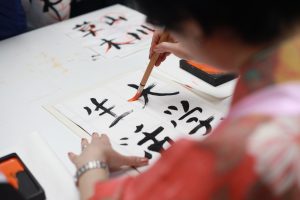
Homophones are words that are pronounced the same but with differing meanings, origins or spellings. If you thought that English has a lot of them, think again! Japanese has numerous homophones, for example ‘shin‘ can have eight different characters and meanings including: ‘God’, ‘to advance’, ‘to believe’, ‘new’, ‘true’, ‘stretch’, ‘heart’, and ‘parent’.
…is one of the fastest spoken languages in the world.
On top of all the linguistic complexities, a recent study revealed that Japanese is the most quickly-spoken language in the world! The average speed at which native speakers of Japanese talk topped the list at a baffling 7.84 syllables per second! To put that into context, English is spoken at a measly 6.19 syllables per second, so make sure to dedicate plenty of time to practising your Japanese comprehension and listening skills.

Inspired to take on the Japanese language? We have face-to-face and online Japanese courses starting very soon. You can find out more here.