
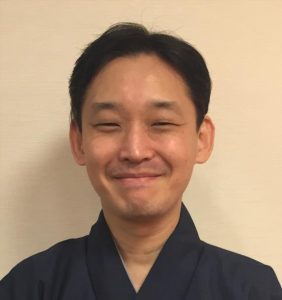
A few months ago one of our Japanese teachers, Aya-Sensei, interviewed rakugo performer Katsura Ryoba-San about rakugo culture. We learned so much about this fascinating art form, and are delighted to say that both are back with another interview. This time we’ll be learning about the history and tradition of the Japanese kimono and how it is used in rakugo theatre.
* * *
Aya: Mr Ryoba is here again! Thank you for coming.
Ryoba: Thank you!
Aya: Today’s topic is the kimono. In rakugo theatre, you always seem to wear a kimono, but are there times when you do rakugo without wearing a kimono?
Ryoba: No, not really. As you know, nowadays, there are almost no people who wear kimonos in Japan regularly. However, since rakugo is a story that began in the Edo period, it is convenient for the setting of the story to wear a kimono when performing. For example, there are stories about occupations that are not modern ones, such as Banto-san and Dettchi-san stories.
Aya: I see, so there is a historical background then. Typically, how many kimonos do rakugo performers have ?
Ryoba: I think it depends on the person, but some performers really have a lot. There are three types of kimonos: awase in winter, hitoe in spring and autumn, and ro / sha in summer. I will dress according to the season. It is a called koromo gae. In the past, there was no air conditioning, and rakugo was sometimes done outdoors, so I think it was important to wear different types of kimonos accordingly. But now that we have air conditioning and heating, I don’t think we need to change kimono as much as we used to.
Aya: I agree. By the way, I think that there are very few people who can dress themselves in a kimono on their own – putting one on correctly is quite a complicated process. Can you do this, Ryoba-san?
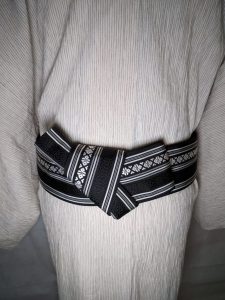
Ryoba: Yes, I can get one on alone. Western clothes are made conveniently with buttons etc, but the kimono is just made with cloth.To wear them we just simply tighten the obi – a wide sash fastened in the back with a bow, worn in Japan as a part of the traditional Kimono. I think the kimono is primitive but easy to wear.
Aya: Wow so you can easily wear one yourself. Amazing! How long does it usually take someone to be able to wear one alone?
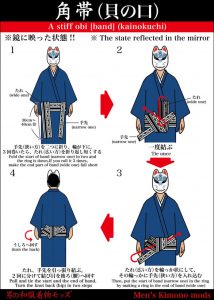
Ryoba: I think it depends on the person. For example, there are various ways to tighten the obi, but rakugo performers usually tighten the obi in a slightly unusual way called kai no kuchi. The knot of the obi is at the back, so it may take a while to be able to tie it at the back.
Aya: There are also kimonos that are like jackets, they are called haori.
Ryoba: Yes that’s right. In the case of rakugo, the haori is also one of the props, so it is taken off to recreate scenes when you come home. It can also be used for a scene change. Also, the haori has always been something to wear when going to other places and having it has been a status for a long time. That’s why even rakugo artists can’t wear haori as a newcomer.
Aya: I see. How else are kimonos utilized in rakugo?
Ryoba: Well for example, in kimonos the sleeves are made into bags, and in the old days people put a lot of things in the sleeves. For example they would give money out of them. This expression is difficult when it comes to Western clothes.
Aya: It’s an old story, that’s why in Japanese culture it’s weird to take money out of your wallet.
Ryoba: Also, the kimono overlaps the chest area, and I take out tenugui from there sometimes. Tenugui is a plain woven cotton cloth for wiping sweat and water after washing the face and hands, and for washing the body when bathing. Therefore, kimono plays an important role in the work of rakugo.
Aya: In rakugo, there are times when you wear the hakama trousers too.
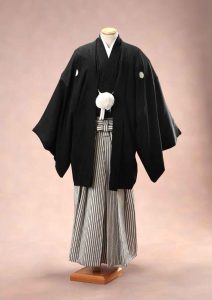
Ryoba: Well, the hakama are also one of the props, and if it is a story in which a samurai appears, the hakama make it easier to imagine the story. It looks gorgeous, and when you’re a young rakugo performer we are normally not able to be wear them.
Aya: It’s very true! Lastly, I would like to ask about the crest of the kimono.
Ryoba: A kimono with a crest is called a mon. I think that in the past, it was the family crest, and I think the crest was proof of which house someone belonged to. When you put a crest on a kimono, you can put one on both sides of the chest, one on the back, one on both sleeves, up to a total of 5 crests, but it costs an additional fee to put the crest on the kimono. There are not many young rakugo performers who wear crests. A black kimono with a crest is the highest rank kimono, but if you wear hakama with it, your status will be extremely high. Even on rakugo stages, if you wear it at the time of the important high seat (the storyteller’s position on stage), the audience will notice it immediately, and the atmosphere will change.
Aya: I understand. I imagine your rakugo master has a lot of kimonos. Do you sometimes receive kimonos from your master that he no longer wears?
Ryoba: Yes, often. I didn’t have a summer kimono, but one day my master called me to his house. Then I said, “How about this?” and I got a few kimono from him.
Aya: That’s nice, isn’t it? You can wear the kimono that your master used to wear again on a stage. Your father was also a rakugo performer, so can you wear your father’s kimonos too?
Ryoba: Today’s kimonos are made of synthetic fibers and can be washed. However, the old kimonos are different, so you have to wash it in a special way called araihari. In the past, we did not wash them a lot. As for how to wash it, we untied the thread, broke it apart, and then washed it by hand. It takes a lot of work to hang it up and then re-sew them again. My father’s kimono is an old kimono and cannot be easily washed, so it is difficult to handle. It is cheap to make with synthetic fibers and easy to wash, so the modern kimono is more convenient.
Aya: Kimonos have also changed with the times. The kimono tradition is profound, and I have learned a lot. Thank you very much. Next time, I would like to speak to you about another topic related to rakugo thetre. Thank you very much.
Everyone, look forward to the next time!
* * *
Find out about learning Japanese with IH London here.