
It’s October! You know what this means…Pumpkin Spice? Halloween? No – Oktoberfest! Also known as the ‘die Wies’n’ in the Bavarian dialect (in the South East of Germany), it’s the largest beer festival or ‘Volksfest’ in the world. The main festival is held in Munich in Bavaria but there are multiple events held across Germany, normally from late September to early October. Historically, the festival originated in 1810 where a great festival celebrated the marriage of Prince Ludwig Bavaria to Princess Therese of Saxe-Hildburghausen. The couple enjoyed the festivities so much, they apparently suggested making it an annual event.
In honour of this event, steeped in the ‘Volkskultur’ (folk culture) of Germany as it is, we decided to dig a bit deeper into the history of Germany and its language in turn, finding some particular language examples; these too are also old in origin and a bit old-fashioned but they are viewed fondly in modern society.
1. Spitzbube
If you were a rogue, scoundrel or even a thief, particularly in a card-game, you may have heard this word thrown at you in the 1500s. Here, ‘spitz’ is understood in its older meaning as an adjective for ‘smart’, ‘insightful’ or ‘cunning’ instead of meaning ‘acute’ or ‘sharp’ as it is known today, whilst ‘Bube’ is an old word for ‘lad’ or ‘knave’. Its origins seem to come from around the 16th century, and later in the 19th century ‘Spitzel’ came to be further used to mean ‘spy’. Today, it is more well-known as a way to describe a beloved biscuit with a jam layer where holes are made in the top, frequently in the form of a smile, also known as ‘Linzer Auge’ – the holes are often interpreted as the gaps through which crooks would spy.
2. Mumpitz
Beware the Mumpitz! This unusual-sounding word stems from Germany’s version of the ‘Boogeyman’, meaning ‘shenanigans’ or ‘nonsense’. Coming into regular usage in 19th century Berlin, the word is derived from ‘Mummelputz’ or ‘Mombotz’, which is composed of the verb ‘vermummern’, meaning ‘to mask/cover oneself up’, and ‘Butzemann’, the old word for a scary Boogeyman. Though not used much in modern German vernacular, it pops up in art, literature and sometimes, even politics!
3. Dreikäsehoch
‘How tall is your boy? Oh, he is only about ‘three cheeses high!’ Yes, this was an actual way that people used to measure and refer to the height of children. Much like the way some of us still say ‘she’s about knee-high’ or a ‘tiny tot’, a ‘Dreikäsehoch’ was often used when describing a curious child who is too small for their ambitions, but tries to act like a “big shot.”. Whilst trade spread during the Middle Ages, cheese rapidly became popular to the point that people came to know the sizes and weight of cheese wheels very well and so they became a standardised means of measuring!
4. Blümerant
Ah nein, sie sieht nicht so gut aus – es wird ihr blümerant! Borrowed from the French, this word is a Germanisation of ‘bleu mourant’ (“pale blue” or more literally, “dying blue”) and particularly during the 19th century, it was used to describe someone looking queasy, as one can look a bit bloodless and pale when about to faint!
5. Hagestolz
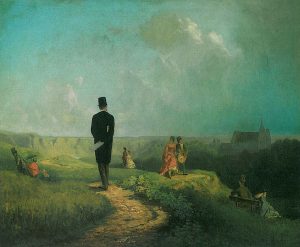
Although it has the traditional definition of meaning a ‘confirmed bachelor’, this word has a lot of socio-political history behind its development going back to the 10-14th century. It descends from the old German word, hagastalt, officially meaning ‘possessor of an enclosure’. Its components are quite literal with ‘stalt’ being a previous iteration of the German verb ‘stellen’ (‘to place/put’), seen today in ‘Anstalt’ or ‘Gestalt’ and ‘Hag’ meaning a small area on a property marked by a hedge. It was used in contrast to the owner of the manor-house, inherited by the eldest son, in accordance with the Old Teutonic inheritance customs, and signified the owner of a small enclosed plot of ground, a role held by any other sons who could not establish a family or set up their own household. These men were often entirely dependent on the eldest brother.
If you want to learn more about the German language and its history, please check out our German courses here!