
One of our favourite things about IH London is the diversity of our staff and students, who come from the four corners of the world and bring with them a wealth of different cultures and languages. Today we’re talking to one of our Arabic language teachers, Rafa, about her ancestral home of Libya, and about some of her experiences growing up bilingually and biculturally.
Tell us a little about yourself.
I was born in Sheffield, England, and grew up in Newcastle upon Tyne and Tripoli, Libya. By definition, I am bilingual/bicultural, and it was always a matter of judging situations to strike a balance between being a Libyan at heart while British in soul. It’s always been difficult to say for sure whether my first language is Libyan Arabic, standard Arabic, Geordie, or anything else. After spending so many years traveling the world in search of myself, I realised that what really matters is effective communication and building relationships based on mutual understanding, and this is what I strive to achieve with my students at IH London.
To me, language entails more than just stringing together well-crafted words. Language is how we communicate with the outside world our thoughts and feelings, which can convey deeper meaning than what we make available to capture on the surface. This idea instigated my PhD project to delve into the world of translation and pragmatics when two languages are involved. Currently, I am a PhD student at SOAS University of London. My research focuses on how humour is conveyed in audio-visual translation from English to Arabic, looking into the layers of meaning in the world of subtitling
What are some of the most interesting places in Libya?
When I returned to Libya as a teenager, I was immediately fascinated by the warm weather, mesmerized by the clear blue sky, and amazed by the turquoise sparkling beaches. It was obvious that I had landed on a different continent, i.e. North Africa.
Tripoli is the capital of Libya and around 3 million people regard it as home (including myself). It is known that Tripoli has always opened its doors to all Libyans from all over the country as well as tourists and foreign skilled workers. Walking around downtown Tripoli, you can feel the city’s cultural convergence throughout its history, for example, the obvious triumph of the Romans is reaffirmed by the sight of Marcus Aurelius Arch. Also, in the heart of Tripoli, there is Al-Saraya al-Hamra (the Red Castle), which is one of the most significant landmarks in the country, and the National museum showcasing the civilizations that passed through Libya (Phoenician – Roman – Greek – Islamic – Ottoman).
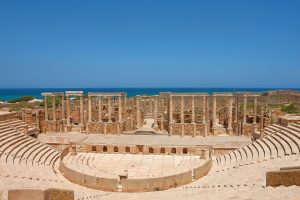
In Libya, the famous city of the Carthaginian Empire of Leptis Magna in the country’s Western region has a wealth of historic diversity. The Roman emperor Septimius Severus, whose grave is in York, UK, ruled Leptis Magna. In addition, cities such as Sabratha, Sousa, and Shahaat have well-preserved Roman and Greek theatres.
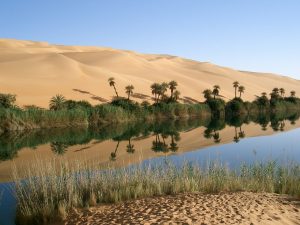
The Libyan desert is a mystery. It is known for the unknown. My first ever encounter with the desert was with the British Council as part of the Green Sahara youth exchange project with Wales. The project entailed participants working on the implications of desertification. We were a group of 20 young people who had the opportunity to drive to the country’s deep south, where the incredible oases of Ubari provide a glimpse of life in the nowhere. The oases were surrounded by huge palm trees and covered by tall sand dunes that reflect a different dimension of Libya’s surreal treasures.
On our way back to Tripoli, we passed by the Ottoman Castle of Sabha, Ghadamas Town known as a UNESCO World history site for being one of the oldest cities in the world, and the magnificent, fortified granary Castle of Nalut depicting the Berber authenticity. I only recently had the opportunity to visit the Eastern Libyan area of Cyrene. Visiting the Green Mountains has long been a dream of mine, and it has finally come true. The beautiful Libyan East offers breath-taking views of gushing springs, high cliffs, cantering wild horses, and ancient Greek ruins.
What can you tell us about Libyan cuisine?
Libyan cuisine is a fusion of various cultures that Libyans have encountered. Couscous is unquestionably regarded as the champion of all dishes in Libya. The typical Libyan couscous is made with lamb on the bone, a spicy thick sauce, caramelised onion topping and a sprinkle of cinnamon on the top. Couscous is served on special occasions, and many families enjoy it as a Friday treat meal (national weekend day). Furthermore, influenced by the Italian heritage, Libyans regard pasta as a national dish, which can be prepared vegetarian, with meat, or with fish.
Also, the Middle Eastern and Turkish influence on Libyan cuisine is vivid in dishes such as Dolma, Tabahij, stews as well as deserts such as Baklava, Kunafe, and Basbosa. However, most popular out of all are the Libyan authentic dishes from Nafusa Mountains as Bazeen, Fatat and Zumita.
More importantly, is the finest quality of coffee that you can find in Tripoli and which is something no one can miss. Mary Fitzgerald, an Irish journalist once tweeted that, “the coffee in #Libya is also vastly superior, you can get a perfect espresso even in little hole-in-the-wall places in Tripoli. Libyans take their coffee very seriously”.
Libya is a hidden gem that has thrived in challenging political circumstances. It may not have been so fortunate in the past, but the faith lies within its future.
_________________________________________________________
A big thank you to Rafa for sharing her experiences with us and introducing us to Libya! Find out more about learning Arabic with IH London here.