
Arabic is the official language in 25 countries and spoken by over 300 million people worldwide, making it the 5th most spoken language in the world. The Arabic language is becoming more and more in-demand for career incentives as it’s one of the 6 official UN languages and highly sought-after by employers. On top of that, the Arabic-speaking world is vast, diverse and unique and learning the language is the pathway to fully immersing yourself into the culture. Studying Arabic is a unique experience and extremely different to learning any other language. In this blog, we will shed light on some fascinating facts about the language and show you why Arabic is the language to learn in 2021.
Did you know that Arabic…
… is at least 1,500 years old.
… doesn’t have an alphabet.
Arabic actually has an ‘abjad‘ system. What is an ‘abjad‘ system you say? Well, Arabic is formed of 28 letters, all of which are consonants, that are accompanied by vowels, which are noted as marks that can be added to the letter or even on top or underneath them. Each letter is written in four different forms for when it is isolated or at the beginning, middle and end of a word.
For example:
‘bā’ (B)
| Isolated Form: | ب |
| At Beginning of Word: | بـ |
| In Middle of Word: | ـبـ |
| At End of Word: | ـب |
… is written from right to left.
Unlike English, Arabic is written from right to left with beautiful cursive writing. Beware: numbers are actually written from left to right, like واحد و عشرون (wāḫed wa-’ishrun = 21), إثنان وعشرون (iṯnāne wa-’ishrun = 22) and so on. It might take some getting used to and thorough practice, but who doesn’t love a challenge?
… includes sounds not found in other languages.
Arabic possesses tons of unique sounds which don’t have an equivalent in any other language, such as ‘haa‘ (ح), ‘kha‘ (خ), ‘ayn‘ (ع), and ‘ghain‘ (غ) which are all pronounced from the throat. Similarly, there are other emphatic consonants pronounced deeper and harder within the throat, like ‘dad‘ (ض), ‘taa‘ (ط) and ‘qaf‘ (ق) to name but a few. When learning Arabic, you will have to teach yourself how to adapt your voice and utilise parts of your mouth and throat that you may never have used before… how exciting!
… has a root system.
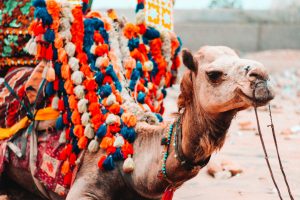
The key to mastering Arabic is becoming familiar with the roots. Every noun, adjective, and verb is built on a root system of 3 key letters, which change with added consonants and vowels. For instance, ‘k-t-b’ (كَتَبَ) carries the meaning of ‘writing’, and various words derive from this same root, like كَاتِب (kātib = writer), كِتَاب (kitāb = book), مَكْتَبَة (maktaba = library) and مَكْتَب (maktab = office/desk). Perhaps this explains why there are many more words in Arabic than in any other language. Linguists estimate that there could be up to a whopping 5,000,000 words in Arabic. To put that in perspective, English only has about 600,000! No wonder there are over 100 words for camel alone…
Feel inspired to take on the Arabic language? Find out more and sign up to one of our upcoming online or face-to-face Modern Standard Arabic classes here.